




Frequently asked questions about the ZOLT app
The necessary container size depends on two factors:
- The dimensions of the waste
- The weight of the waste
As you place your container order, you will see the dimensions and maximum allowed weight capacity of each container. As you contemplate the order, please take both these factors into consideration.
The following are the maximum loaded weights of each container size:
- 6m3-7m3 = 4,5 tonnes
- 8m3 = 7,5 tonnes
- 9m3-10m3 = 8 tonnes
- 12m3 = 9 tonnes
- 15m3 = 11 tonnes
- 20m3 = 11,5 tonnes
Construction waste containers must never be filled with any hazardous waste (tyres, asbestos-containing materials etc.) and household (food) waste.
The customer may retain a container for up to 3 (three) business days, not including the day of delivery. Each subsequent day is subject to a charge of EUR 2 per 6–10 m3 container and EUR 5 per 12–20 m3 container.
Construction waste includes the majority of waste generated as a result of building or dismantling activity, with the exception of hazardous and household waste.
Use the ZOLT app to cancel a paid order of a container.
Order cancellation –
- No less than 24 (twenty-four) hours prior to scheduled provision of the Service – ZOLT withholds a charge of EUR 10.00 (ten euros, 00 cents) for order handling and Service processing (commission fee), refunding the remainder to the Customer within no more than 14 (fourteen) days following Order cancellation.
- On the scheduled Service provision date, but no less than 2 (two) hours prior to the scheduled provision of the Service – ZOLT does not refund to the Customer (withholds) 25% of the fee for the Service stated in the Customer’s Order. The remaining 75% of the received payment will be refunded by ZOLT to the Customer within 14 (fourteen) days following Order cancellation.
- Less than 2 (two) hours prior to the scheduled provision of the Service – ZOLT does not refund the fee for the service stated in the Customer’s Order; 100% of the Service fee paid by the Customer is withheld.
Hazardous waste may be delivered to specially outfitted waste handling locations – please go to - https://www.atkritumi.lv/lv/karte/ to find out more.
You may only order a container for the next business day if you place the order by 15:00 of the current business day.
The carrier will contact the customer with a request to remove the excess weight; otherwise, the container will be removed, and an invoice for travelling from the carrier’s base location to the customer’s site will be issued.
Collected construction waste is delivered to construction waste sorting sites for processing. Suitable sorted waste is transported for disposal, while unsuitable waste is buried in a landfill.
You pay a standard fee for your container in every case.
We recommend ordering a container once you are ready to fill it up.
No! Moving containers is prohibited unless there is an express arrangement to the contrary!
If minor container damage (dents etc.) is identified, no extra charges apply.
If the container is deformed, burned or otherwise damaged, repairs are borne by the customer; if the container is damaged beyond repair, the customer is charged for its value.
You submit a request indicating the address, approximate weight, and metal type. Then the scrap metal is collected and weighed. If you deliver the scrap metal to the specified location yourself, it will be weighed on site. Payment for the accepted scrap metal is transferred to your bank account (minus transport costs).
The payout depends on the type, quantity, and quality of the scrap metal, as well as the purchase price at the time of handover. Weighing is done on certified scales, and a contamination percentage (non-metal impurities) may be applied.
No. Payments are made by bank transfer to the supplier’s account, typically within 24 hours.
For individuals: an identity document (eID/passport) and bank account details. When handing over a vehicle, vehicle documents are usually also required (e.g., registration certificate).
Yes. The scrap metal buyer withholds 10% personal income tax and transfers it to the state budget.
No. Purchasing scrap metal in Latvia is allowed only for licensed companies (with a licence issued by the State Environmental Service).
Quantity is determined using certified scales. Quality is assessed by a qualified receiver; measuring instruments may be used if necessary. Non-separable non-metal impurities (contamination) may be excluded from payment, so it is recommended to clean the metal as much as possible.
Only scrap metal (metal structures, steel, cast iron, etc.). If you are unsure about a specific item, note it in the request comments or contact customer support.
For example: household/bio waste, car spare parts and tyres, hazardous waste (paints, oils, solvents, etc.), glass, liquids or materials that harden, accumulators/batteries, electrical equipment, solar panels, fluorescent bulbs/LED lamps, asbestos slate, thermometers, aerosols/chemicals, textiles, etc.
An additional invoice may be issued for sorting/disposal of unsuitable waste, disposal of hazardous waste, and extra labour costs. Fines may also be applied for violations.
Additional costs may be charged for issues arising during transport (e.g., extra transport, manual handling, or reloading), typically billed at an hourly rate. Waiting/idle time fees may apply after the free period.
It depends on the service terms. The container rental fee may start from a specific business day (as defined in the partner’s service terms).
Sort metals by type (ferrous/non-ferrous), remove non-metal parts (plastic, rubber, wood), drain liquids from units, and, if possible, cut large structures for easier loading (this helps reduce the contamination percentage and speeds up acceptance).
The necessary container size depends on two factors:
- The dimensions of the waste
- The weight of the waste
As you place your container order, you will see the dimensions and maximum allowed weight capacity of each container. As you contemplate the order, please take both these factors into consideration.
Construction waste containers must never be filled with any hazardous waste (tyres, asbestos-containing materials etc.) and household (food) waste.
Construction waste includes the majority of waste generated as a result of building or dismantling activity, with the exception of hazardous and household waste.
Hazardous waste may be delivered to specially outfitted waste handling locations – please go to - https://www.atkritumi.lv/lv/karte/ to find out more.
The carrier will contact the customer with a request to remove the excess weight; otherwise, the container will be removed, and an invoice for travelling from the carrier’s base location to the customer’s site will be issued.
You pay a standard fee for your container in every case.
We recommend ordering a container once you are ready to fill it up.
If minor container damage (dents etc.) is identified, no extra charges apply.
If the container is deformed, burned or otherwise damaged, repairs are borne by the customer; if the container is damaged beyond repair, the customer is charged for its value.
The payout depends on the type, quantity, and quality of the scrap metal, as well as the purchase price at the time of handover. Weighing is done on certified scales, and a contamination percentage (non-metal impurities) may be applied.
For individuals: an identity document (eID/passport) and bank account details. When handing over a vehicle, vehicle documents are usually also required (e.g., registration certificate).
No. Purchasing scrap metal in Latvia is allowed only for licensed companies (with a licence issued by the State Environmental Service).
Only scrap metal (metal structures, steel, cast iron, etc.). If you are unsure about a specific item, note it in the request comments or contact customer support.
An additional invoice may be issued for sorting/disposal of unsuitable waste, disposal of hazardous waste, and extra labour costs. Fines may also be applied for violations.
It depends on the service terms. The container rental fee may start from a specific business day (as defined in the partner’s service terms).
The following are the maximum loaded weights of each container size:
- 6m3-7m3 = 4,5 tonnes
- 8m3 = 7,5 tonnes
- 9m3-10m3 = 8 tonnes
- 12m3 = 9 tonnes
- 15m3 = 11 tonnes
- 20m3 = 11,5 tonnes
The customer may retain a container for up to 3 (three) business days, not including the day of delivery. Each subsequent day is subject to a charge of EUR 2 per 6–10 m3 container and EUR 5 per 12–20 m3 container.
Use the ZOLT app to cancel a paid order of a container.
Order cancellation –
- No less than 24 (twenty-four) hours prior to scheduled provision of the Service – ZOLT withholds a charge of EUR 10.00 (ten euros, 00 cents) for order handling and Service processing (commission fee), refunding the remainder to the Customer within no more than 14 (fourteen) days following Order cancellation.
- On the scheduled Service provision date, but no less than 2 (two) hours prior to the scheduled provision of the Service – ZOLT does not refund to the Customer (withholds) 25% of the fee for the Service stated in the Customer’s Order. The remaining 75% of the received payment will be refunded by ZOLT to the Customer within 14 (fourteen) days following Order cancellation.
- Less than 2 (two) hours prior to the scheduled provision of the Service – ZOLT does not refund the fee for the service stated in the Customer’s Order; 100% of the Service fee paid by the Customer is withheld.
You may only order a container for the next business day if you place the order by 15:00 of the current business day.
Collected construction waste is delivered to construction waste sorting sites for processing. Suitable sorted waste is transported for disposal, while unsuitable waste is buried in a landfill.
No! Moving containers is prohibited unless there is an express arrangement to the contrary!
You submit a request indicating the address, approximate weight, and metal type. Then the scrap metal is collected and weighed. If you deliver the scrap metal to the specified location yourself, it will be weighed on site. Payment for the accepted scrap metal is transferred to your bank account (minus transport costs).
No. Payments are made by bank transfer to the supplier’s account, typically within 24 hours.
Yes. The scrap metal buyer withholds 10% personal income tax and transfers it to the state budget.
Quantity is determined using certified scales. Quality is assessed by a qualified receiver; measuring instruments may be used if necessary. Non-separable non-metal impurities (contamination) may be excluded from payment, so it is recommended to clean the metal as much as possible.
For example: household/bio waste, car spare parts and tyres, hazardous waste (paints, oils, solvents, etc.), glass, liquids or materials that harden, accumulators/batteries, electrical equipment, solar panels, fluorescent bulbs/LED lamps, asbestos slate, thermometers, aerosols/chemicals, textiles, etc.
Additional costs may be charged for issues arising during transport (e.g., extra transport, manual handling, or reloading), typically billed at an hourly rate. Waiting/idle time fees may apply after the free period.
Sort metals by type (ferrous/non-ferrous), remove non-metal parts (plastic, rubber, wood), drain liquids from units, and, if possible, cut large structures for easier loading (this helps reduce the contamination percentage and speeds up acceptance).
Download the mobile app from Google Play or the App Store
 Google Play
 App Store






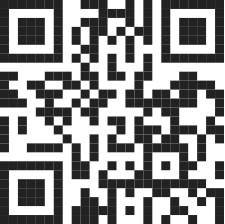
 Scan this code with your phone's camera